Last Week's Rotary Meeting 9th June 2026
Welcome & Opening
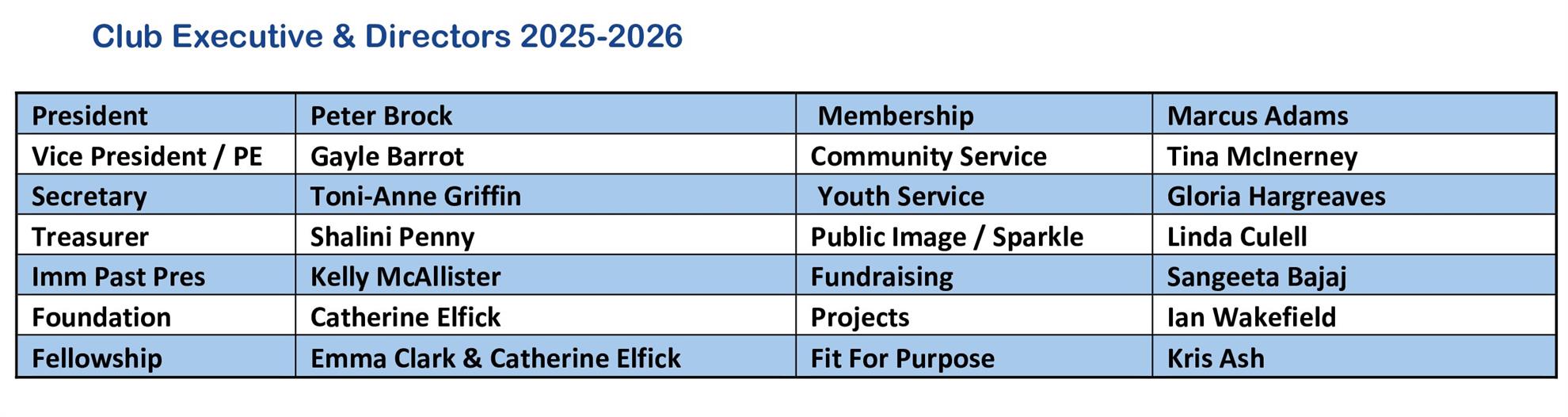
President Peter Brock opened the 46th meeting for his term, welcoming members, guests and Chairperson Shalini Penny.
Guest Speakers: Kerry O'Leary - end-of-life doula
Death is the one experience every single one of us will share… and yet it’s the one we almost never talk about.
We plan for holidays. We plan for careers. We plan for retirement. we rarely plan for the final chapter of our lives.
And because we avoid the conversation, we often leave the people we love with uncertainty… and pressure… at a time when they’re already overwhelmed.
The Brownsville Project found that most people die without a nominated decision‑maker. That means someone else — usually a family member — is left to guess what you would have wanted. And guessing is a heavy burden.
That’s why an Advance Care Directive matters. It’s not just a form. It’s your voice when you can’t speak. It records what quality of life means to you, what treatments you want or don’t want, and where your boundaries lie.
I’ve worked with people like Christine, whose wishes weren’t recorded. Her family wanted to do the right thing, but they didn’t know what “the right thing” was.
And people like Gabby, who faced her final chapter with clarity. She wrote down exactly what she wanted — her vigil, her visitors, her music. Her family didn’t have to guess. They simply honoured her.
Preparation is both practical and emotional. It means asking yourself: What are my fears? What does quality of life mean to me? How do I want to be remembered?
These conversations can be hard. Families often shut them down: “No, no, you’re not going to die. Let’s not talk about that.”
But avoiding the topic doesn’t prevent death. It only prevents clarity.
So, record your wishes anyway. Tell your doctor. Upload them to My Health Record. Make sure someone can find them.
And remember — you have options. More than most people realise. You can bring a body home. You can hold a vigil. You can choose how you want to be honoured.
My message is simple: Think about your end of life. Write it down. Share it. It’s not morbid. It’s an act of love — for yourself, and for the people who will one day stand beside you.
An Article written by PP PHF John Ritchie
Many years ago I went to work for a feed mill
Feed mills are attached to flour mills
Because the excess bran is used by the feed mill
One day someone took me through the flour mill
I noticed that the wheat germ came out of a small shoot into a bag
They told me it was sold to health food stores for a premium price
I got upset by this because we live on flour it’s in a lot of our food and we are not getting the vitamin E which is in the germ
So, I started taking vitamin E capsules
Vitamin E is a very important vitamin
It crops up in a lot of reactions in the body
The symptoms of deficiency is capillaries fragility
A stroke can be capillary fragility
Recently I found I was waking up with small bruises on the back of my hand, so I increased the dose size from 500 to 1000iu and the problem stopped
There is no known toxic dose
People who are taking vitamin E survive a heart attack
Those who don’t know Vitamin E helps healing without scar tissue
It is an antioxidant vitamin which is soluble in fat, so you don’t lose it you store it up and use it when you need it
I think it might help allergies because the immune system produces peroxide to remove invading organisms
Vitamin E can then remove the excess before it does damage to your own tissue
Yours Sincerely
John Ritchie